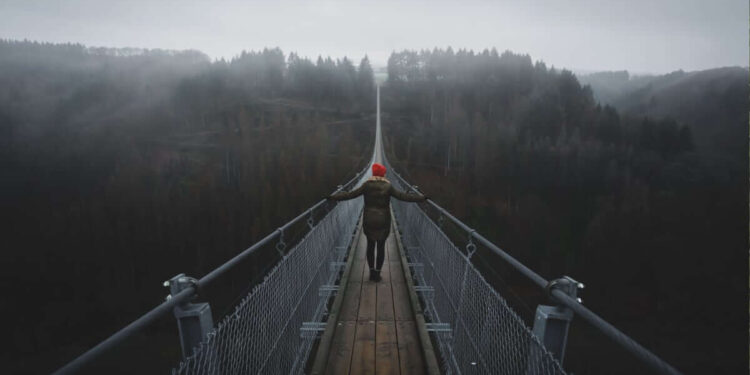
Fear is an effect of trauma, big or small, physical or emotional, and it comes to the fore when we come into contact with something that, for understandably subjective reasons, refers us back to that trauma, even unconsciously.
The title of this post is a phrase I read years ago in a book about the Continuum movement, Life on Land, written by the person who discovered the Continuum: Emilie Conrad.
There are small strategies for approaching fear and transforming it from a bitter enemy into a trusted traveling companion.
The natural and spontaneous movement of the body
The Continuum is a somatic approach based on the natural and spontaneous movement of the body, also accompanied by sounds, when the body has left the aquatic dimension and entered in contact with the terrestrial one. It is a very slow and gradual process, made of deep listening, adaptations and possibilities, which the body discovers little by little, in a continuum.
However, this phrase is not only valid for the Continuum; the message it conveys I believe can be extended, in an absolute sense, to all our incarnated experience. Why? Because fear freezes. And, of course, it does so to protect.
Transforming fear
What does the body do? It contracts, it blocks, and activates the only defense mechanism it is capable of setting in motion at that moment, fear, which is the fear of pain, of returning to a maelstrom of discomfort and suffering, of being reunited with the unpleasant event that generated it all.
There are small strategies for approaching fear and transforming it from a bitter enemy into a trusted traveling companion.
For example, to begin to see it as Fear and not as terror, assigning it an ontological identity, as if it were a person. Seen in this way, it already loses much of its terrifying power because our unconscious automatically attributes human characteristics to it.
If it becomes Fear, somehow, you will also be afraid. Already by writing it down, it seems to me that it becomes smaller and more accessible. The encounter with Fear puts us in a position to reconstruct the relationship with the archetype itself, to go and act on the ground, to “defuse the bomb”.
Establish a dialogue, asking it what you want to communicate, and wait for an answer, which comes from the body, and then continue, like a matryoshka, to unravel the skein, and perhaps understand the meaning of its intervention.
The reactions of our body
Another small suggestion is to try to accompany the fear with a symbolic movement of the body (for example, lifting the leg, turning an arm backwards, tensing the torso, or bending down, closing the eyes… ), which becomes a means of support and integration, which occurs in small steps, which comes from the experience.
In practice, we use the “symptoms” of fear as steps to return, little by little, to the origin. It is not necessarily arrived at immediately, it may take some time, but it is certainly an authentic way of arriving.
Otherwise, if we have the possibility, we can use the alternative of a walk… in the countryside. Not for anything else, but because a forest is a realistic projection of our inner labyrinthine dimension; the same one in which we get lost when we are afraid, where we encounter undefined shapes, vague sensations, hidden creatures, etc…
To cross the forest, physically, is to move symbolically to the places inside. To know small animals, plants, rocks, insects, is to see, and therefore to recognize, the symptoms of fear when it is triggered.
One can begin to familiarize oneself with the jungle dimension, if one is not so familiar with it, by reading some fairy tales, but also the Brothers Grimm offer ample symbolic material on which to begin to work, to weave a link with reality.
Reading a fairy tale with body awareness, letting oneself be impregnated by the power of symbols, is already a strong experience. In any case, I recommend going to the forest, if only to be in contact with the master Nature.
It does not matter if it is a relational modality, somatic awareness or exploration with the physical. These are the three expressions of movement, which transforms fear into our friend, and does so through the body.